Artificial intelligence did not arrive with a dramatic announcement. There was no single moment where the world suddenly “switched” to AI. Instead, it slipped quietly into our daily routines. First as autocomplete, then as recommendations, then as assistants that draft, analyse, suggest, and even challenge our thinking.
Today, AI is no longer a future concept. It is already influencing how we work, how we process information, and how we make decisions — often without us realising it. The real shift is not that machines are becoming smarter. It is that human work itself is being redefined.
For decades, software followed instructions. If we wanted results, we had to tell systems exactly what to do, step by step. AI changed that relationship.
Modern AI systems do not just execute commands. They interpret intent, recognise patterns, and propose actions. This subtle difference has quietly reshaped workflows across industries — from writing and design to strategy and operations.
What makes this transformation unusual is its invisibility. Unlike past technological revolutions, AI does not replace tools outright. It embeds itself into existing ones. To understand the scale of this change, it helps to look at how work itself is evolving.
From Tools to Thinking Systems
Traditional tools are reactive. AI systems are anticipatory. Where older software waited for input, AI systems now:
-
infer context
-
predict next steps
-
offer alternatives
-
flag risks before they happen
This shift changes how humans engage with technology. Instead of micromanaging processes, we increasingly collaborate with systems that think alongside us.
A rare but important distinction emerges here:
Automation replaces tasks.
AI reshapes judgment.
That difference is why AI feels less disruptive on the surface, yet more transformative underneath.
How AI Is Quietly Changing Daily Workflows
Most people associate AI with big breakthroughs. In reality, its biggest impact comes from small, repeated interactions. Below is a simplified comparison of how workflows are changing.
| Area of Work | Before AI | With AI |
|---|---|---|
| Writing | Start from a blank page | Start from structured drafts and ideas |
| Research | Manual searching and summarising | Rapid synthesis across sources |
| Design | Linear ideation | Iterative concept exploration |
| Coding | Syntax-driven problem solving | Intent-driven solution building |
| Operations | Manual reporting | Automated insights and alerts |
| Decision-making | Experience-based intuition | Data-supported judgment |
Individually, these changes seem minor. Collectively, they redefine productivity. A rarely discussed fact is that AI reduces cognitive friction, not workload. People still work hard — but they spend less energy on starting, searching, and structuring.
AI and the Subtle Shift in Decision-Making
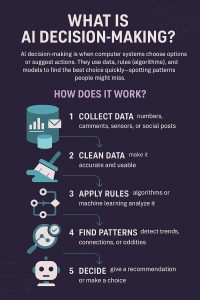
One of AI’s most underestimated impacts is on how decisions are formed. AI does not usually make decisions for us. Instead, it:
-
reframes options
-
highlights patterns we might miss
-
surfaces second-order consequences
-
forces clarity in problem definition
This leads to a phenomenon researchers call decision acceleration. Decisions are not necessarily faster — they are better informed earlier.
A rare insight here is that AI changes when we decide, not just what we decide. By reducing uncertainty upfront, it compresses the decision cycle.
However, this also introduces risk. When AI outputs are treated as authority rather than input, human judgment weakens. The strongest results come when AI is used as a thinking partner, not a replacement.
Human Skills That Become More Valuable in an AI World
Contrary to popular belief, AI does not reduce the value of human skills. It redistributes them. As AI handles execution and synthesis, certain human abilities increase in importance:
-
problem framing and asking the right questions
-
contextual understanding
-
ethical judgment
-
creative direction
-
sense-making across ambiguity
A rare but critical observation is this:
AI rewards clarity of thought more than technical expertise.
Those who can articulate intent, constraints, and desired outcomes benefit the most — regardless of industry.
Common Misconceptions That Still Hold People Back
Despite widespread adoption, several myths persist:
-
AI will replace all meaningful work
-
AI outputs are always accurate
-
AI is only useful for technical roles
-
Using AI reduces original thinking
In reality, AI amplifies whatever thinking already exists. Poor inputs produce shallow results. Strong thinking produces leverage. The difference is not access to AI. It is the quality of interaction with it.
Where This Quiet Transformation Is Heading
The next phase of AI will not feel louder. It will feel more personal. We are moving toward:
-
AI embedded directly into workflows
-
personalised assistants that adapt over time
-
systems that understand preferences, not just prompts
-
collaboration models where AI operates in the background
This shift matters because the most powerful AI will be the least visible. It will feel less like “using a tool” and more like “thinking with support”.
Those who recognise how AI reshapes thinking can:
-
design better workflows
-
make stronger decisions under uncertainty
-
reduce cognitive overload
-
focus energy on high-impact work
This is not about becoming more technical. It is about becoming more intentional. AI does not reward speed alone. It rewards direction.
The question is no longer whether AI will change the way we work. That change is already underway. The real question is whether we engage with it consciously or passively. By learning how AI influences thinking, decision-making, and judgment, we can use it to enhance human capability rather than dilute it. Those who adapt thoughtfully will not just keep up — they will shape how work itself evolves.