Many businesses proudly say, “We already have a website.”
But when we look closer, that website often exists only to tick a box — not to grow the business.
An evergreen truth remains: a website that doesn’t generate leads, authority, or data is not an asset — it’s a liability.
In this article, we break down why websites fail, what makes a website a real digital asset, and how to rethink your website as a growth engine — not just a digital flyer.
#1: The Real Problem — Websites That Simply “Exist”
Most underperforming websites share the same symptoms:
-
They exist just to show company info
-
They don’t attract qualified traffic
-
They don’t convert visitors into leads
-
They don’t support SEO, branding, or trust
In short, they don’t work for the business.
A website should actively help with:
-
Sales enablement
-
Reputation building
-
Search visibility
-
Audience education
If it does none of these, it’s not an asset.
#2: Why This Issue Still Matters (Even in 2025)
People keep asking:
-
Why is my website not generating leads?
-
Is a website still important in 2025?
-
Do we even need a website when we have social media?
These questions are powerful because they reveal a misunderstanding.
Social platforms rent attention.
Your website owns it.
In an AI-first, search-driven world:
-
AI models reference structured, authoritative websites
-
Search engines reward helpful, intent-based content
-
Buyers research deeply before contacting anyone
A strong website is now more important — not less.
#3: Website vs Brochure — A Critical Comparison
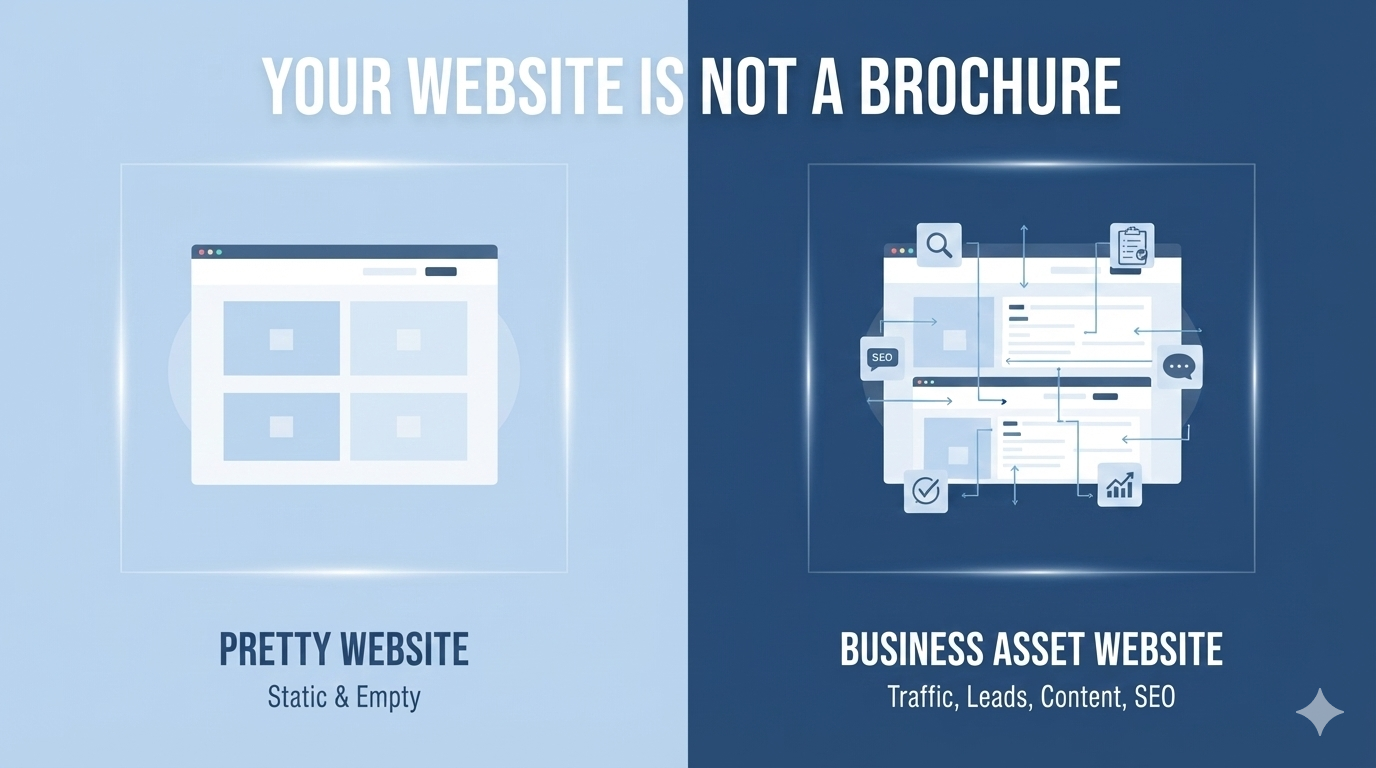
| Brochure Website | Business Asset Website |
|---|---|
| Static pages | Dynamic, evolving content |
| About-centric | User & problem-centric |
| No clear CTA | Strategic conversion paths |
| No SEO structure | Search & AI-optimised |
| Looks good | Works hard |
A brochure informs.
An asset performs.
#4: What Actually Makes a Website a Digital Asset
A real digital asset does at least one of these consistently — ideally all:
-
Generates qualified leads
-
Builds authority and trust
-
Ranks for meaningful search queries
-
Supports marketing, sales, and content efforts
-
Feeds data into decision-making
Think of your website as a hub, not a destination:
-
Content flows into it
-
Traffic lands on it
-
Conversions happen within it
This is where design, development, and content stop being silos — and start working together.
#5: The Strategic Role of Content, Design & Structure
A high-performing website is never built backwards.
It starts with:
-
Intent — what problems are we solving?
-
Structure — how users and search engines navigate
-
Content — what answers we provide
-
Design — how clarity and trust are reinforced
When these align:
-
SEO improves naturally
-
Users stay longer
-
AI systems can understand and reference your site
This is why modern websites are systems, not just pages.
#6: Rethinking Your Website as a Growth Engine
If we strip everything down, the question becomes simple:
Is our website helping us grow — or just sitting there?
A website that functions as an asset:
-
Evolves with your business
-
Supports new services and ideas
-
Scales with content and strategy
-
Compounds value over time
When approached correctly, a website quietly does the heavy lifting — while you focus on running the business.
We believe websites should earn their keep.
That’s why we approach web projects holistically — combining strategy, content, design, and technical structure so the website works long after it goes live.
If your website already exists, it can almost always be repositioned, restructured, and repurposed into something more valuable.