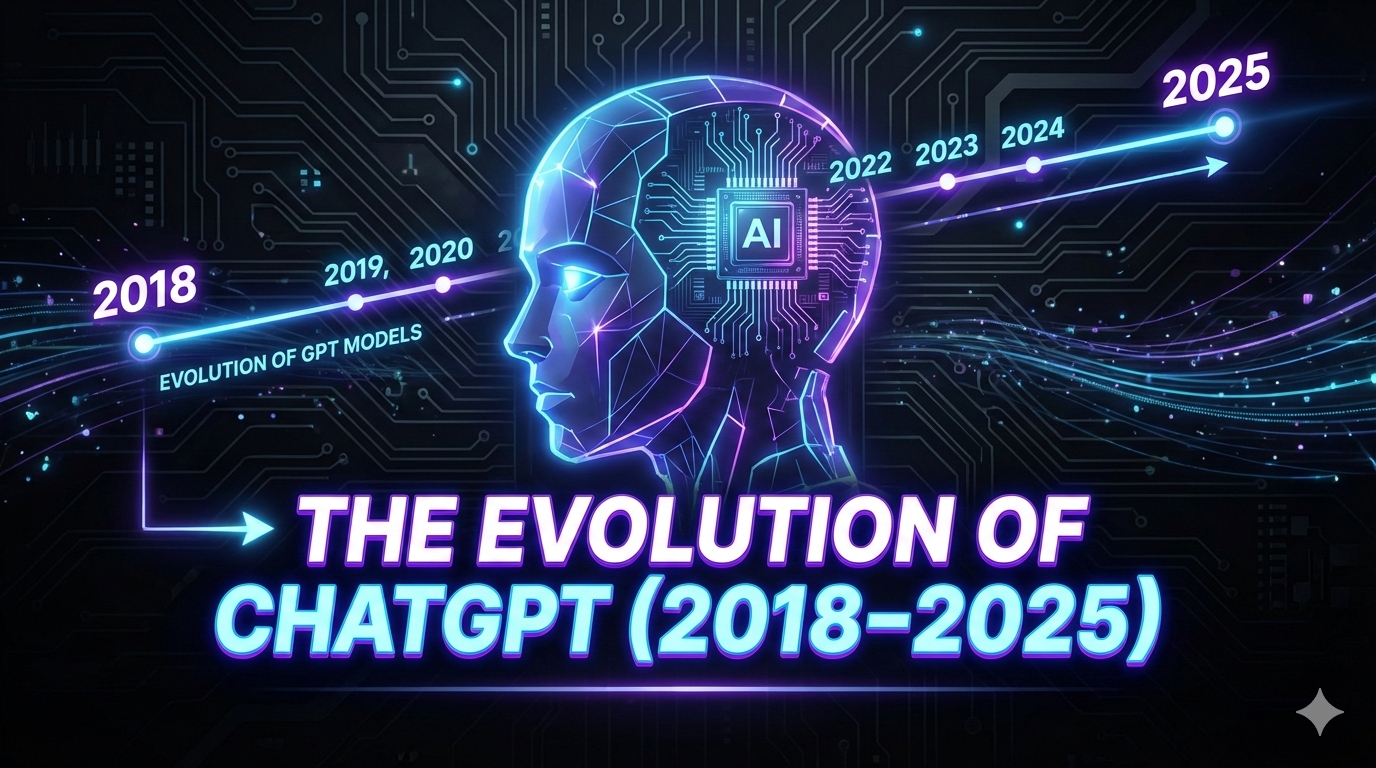
Artificial intelligence has grown faster in the last few years than in the previous few decades combined. One of the biggest drivers of that growth is the GPT family of models — the engine behind ChatGPT. What began as a research experiment in 2018 has now transformed into a highly intelligent assistant that millions of people rely on daily.
Yet many users still wonder:
How did GPT evolve this quickly? What changed between each version? And how long did each leap take?
In this article, we break down the entire evolution of GPT — from GPT-1 to the latest GPT-5.2 — in a clear, human-readable timeline.
Each generation of GPT improved on the weaknesses of the previous one. Instead of treating AI as a black box, we believe it’s important to understand the milestones that shaped today’s tools.
Below is a chronological table summarising GPT’s development path before we explore each version in depth.
📊 Chronological Timeline of GPT Models (2018–2025)
| Model | Release Date | Key Improvements | Time to Next Model |
|---|---|---|---|
| GPT-1 | Jun 2018 | First transformer-based language model; research only. | ~8 months |
| GPT-2 | Feb 2019 | 1.5B parameters, coherent text generation, global attention. | ~20 months |
| GPT-3 | Jun 2020 | 175B parameters, major leap in reasoning & text generation. | ~30 months |
| GPT-3.5 | Nov 2022 | Instruction tuning; foundation of early ChatGPT. | ~4 months |
| ChatGPT (public debut) | 30 Nov 2022 | Conversational interface used by the public. | → GPT-4 in 4 months |
| GPT-4 | 14 Mar 2023 | Multimodal (text + image), improved reasoning. | ~23 months |
| GPT-4.5 | Feb–Mar 2025 | Faster, more consistent, fewer hallucinations. | ~5 months |
| GPT-5 | 7 Aug 2025 | Dynamic task routing, deeper reasoning. | ~4 months |
| GPT-5.2 | 11 Dec 2025 | Current flagship model; more stable, natural, and productive. | — |
2018 — GPT-1: The Beginning of Modern AI
GPT-1 was small by today’s standards, but it proved something extraordinary:
a transformer model could learn patterns of language at scale.
It had only 117M parameters, yet it laid the foundation for everything that followed.
Why it matters:
GPT-1 wasn’t about performance — it was about proving the concept.
2019 — GPT-2: The First Model That Shocked the Public
GPT-2 generated text that was coherent, persuasive, and surprisingly human-like.
It was so capable that, initially, OpenAI chose not to release the full model due to concerns about misuse.
This was the moment the world began paying attention.
Time to next version: ~20 months
2020 — GPT-3: The Giant Leap
GPT-3 scaled to 175 billion parameters, enabling:
-
long-form writing
-
code generation
-
logical reasoning
-
creative storytelling
Developers began using GPT-3 to build real applications — not just demos.
This model marked the start of AI’s integration into everyday workflows.
2022 — GPT-3.5 & the Birth of ChatGPT
GPT-3.5 refined instruction-following, conversation, and context handling.
On 30 November 2022, ChatGPT was launched to the public, and within five days, it reached 1 million users — a milestone no consumer technology had ever achieved that fast.
This was the moment AI stopped being theoretical and became a daily tool.
2023 — GPT-4: Multimodal Intelligence Arrives
GPT-4 introduced:
-
image understanding
-
higher reasoning accuracy
-
better long-form analysis
-
stronger safety controls
Professionals began using it for coding, research, UX design, data analysis, and automation.
GPT-4 blurred the line between “AI assistant” and “AI collaborator.”
2025 — GPT-4.5: A Smoother, Faster, More Reliable AI
GPT-4.5 served as a transition model — bridging the gap before GPT-5.
It offered:
-
lower latency
-
more consistent reasoning
-
reduced hallucination rates
-
better complex instruction handling
It became the preferred model for industries requiring stability and accuracy.
2025 — GPT-5: The First Model That Felt Truly Adaptive
GPT-5 introduced a major breakthrough:
Dynamic Task Routing
The model could internally decide how to solve a task, not just respond to text.
This made a dramatic difference in:
-
technical problem-solving
-
multi-step reasoning
-
adapting tone and writing style
-
long document comprehension
For many users, GPT-5 was the first version that felt like a genuine partner for deep thinking.
December 2025 — GPT-5.2: Productivity and Natural Reasoning Redefined
GPT-5.2, the model many of us use today, focuses on:
-
smoother reasoning
-
more lifelike conversational flow
-
better contextual memory
-
stronger analysis capabilities
-
improved task planning
It was designed to feel less like a chatbot and more like a reliable assistant — fast, stable, and clear.
Why Understanding This Timeline Matters
Knowing how GPT evolved isn’t just trivia — it helps us understand:
-
how quickly AI is moving
-
what capabilities we can expect next
-
how businesses can prepare for the next shift
-
how we can use these tools more effectively in our own workflows
When we see the trajectory, we also see one important truth:
Every version of GPT made us rethink what’s possible.
And the pace is not slowing down.
Stay Ahead of the AI Curve
We believe the next leaps in AI will be even more transformative — from autonomy to personalized agents to real-time learning.
If you’re interested in technology, automation, or the future of work, follow our future articles where we break down complex topics into practical insights anyone can apply.
AI will continue evolving whether we keep up or not — but with the right understanding, we can stay ahead of the curve and build things that truly matter.