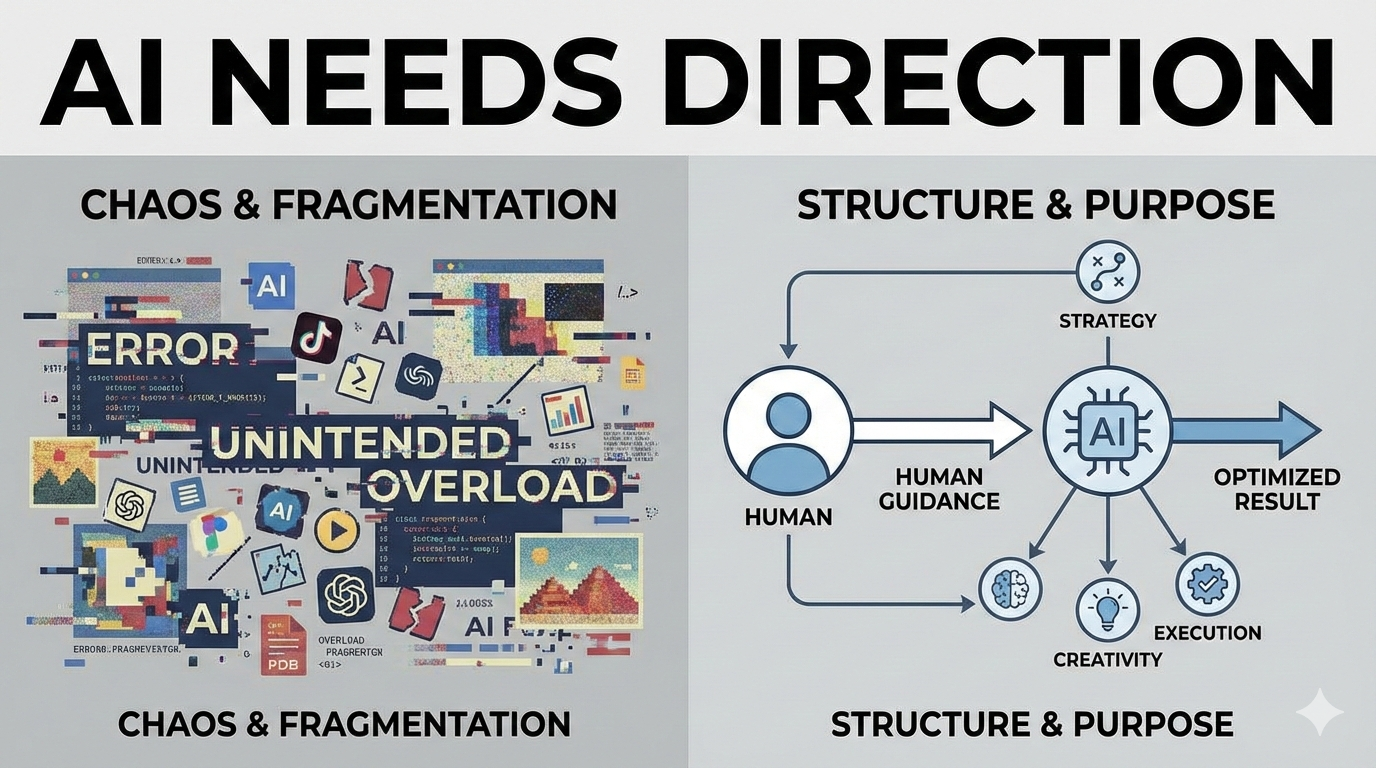
AI is everywhere. Everyone is “using AI.”
Yet many organisations quietly face the same problem: the more AI they use, the messier their output becomes.
Content feels disconnected. Brand voice drifts. Teams move fast—but not forward.
This isn’t an AI problem.
It’s a direction problem.
In this article, we break down why AI often creates chaos instead of clarity—and how a structured, AI-assisted workflow turns AI into a strategic advantage rather than a liability.
AI Chaos in Organisations: What’s Actually Going Wrong

They lack alignment.
Common symptoms we see across organisations:
-
Inconsistent tone across platforms
-
Brand identity slowly dissolving
-
Content quality swinging from excellent to unusable
-
Teams relying on “prompt luck” instead of repeatable results
When everyone uses AI differently, the organisation doesn’t scale—it fragments.
Why “Everyone Using AI” Is Not a Strategy
AI adoption often starts with enthusiasm, not design.
People ask:
-
“Which AI tool should we use?”
-
“Can AI generate content faster?”
But the more important question is:
How does AI fit into our system of thinking, writing, and decision-making?
Without a shared structure:
-
AI outputs mirror individual habits, not organisational standards
-
Speed increases, but coherence disappears
-
Teams confuse productivity with progress
AI amplifies whatever system already exists.
If the system is unclear, AI multiplies the chaos.
The Real Cost of Inconsistent AI Usage
AI chaos doesn’t always look dramatic.
It looks quietly expensive.
| Issue | What It Looks Like | Hidden Cost |
|---|---|---|
| Tone inconsistency | Different “voices” across content | Brand trust erosion |
| Fragmented outputs | No reusable structure | Time wasted rewriting |
| AI dependency | Blind acceptance of AI drafts | Lower editorial quality |
| Tool-driven workflow | Tools decide the process | Loss of strategic control |
Over time, this weakens positioning—even if output volume increases.
AI Is Not the Problem — Direction Is
Here’s the core principle we work with:
AI is not a shortcut. It is a system multiplier.
Used raw, AI reflects randomness.
Used with direction, AI reflects intent.
The difference lies in:
-
Clear content frameworks
-
Defined brand voice parameters
-
Agreed decision rules
-
Human checkpoints that matter
AI should serve the system—not replace it.
What an AI-Assisted Workflow Actually Looks Like


A healthy AI workflow is assisted, not automated.
Typical structure:
-
Human sets intent (goal, audience, angle)
-
System defines boundaries (tone, structure, constraints)
-
AI accelerates execution (drafting, variations, synthesis)
-
Human applies judgment (context, nuance, alignment)
AI works best when it handles speed—not meaning.
From Tool Users to System Thinkers
The organisations that win with AI don’t chase tools.
They design thinking systems.
They:
-
Treat AI as infrastructure, not magic
-
Build repeatable workflows instead of clever prompts
-
Position humans as editors, strategists, and decision-makers
This shift—from tool usage to system ownership—is what separates AI chaos from AI leverage.
Direction Before Automation
AI will not fix unclear strategy.
It will only make it louder.
When direction comes first:
-
Output becomes consistent
-
Teams move faster together
-
Brand identity strengthens instead of dissolving
That’s where AI becomes powerful—not as a shortcut, but as a force multiplier.
And that’s the mindset behind everything we build, document, and share on this site.