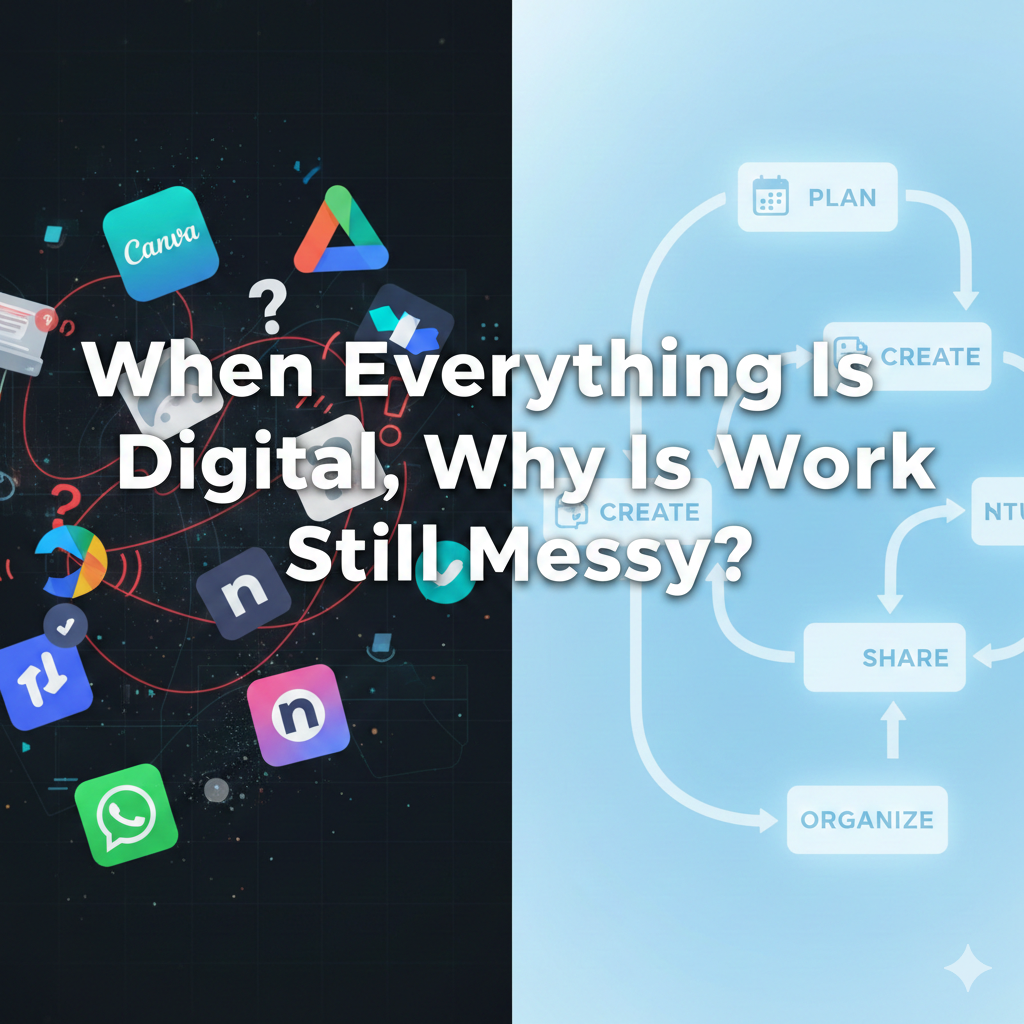
Solving Fragmented Digital Operations for Small Teams
Digital tools were supposed to make work easier.
Instead, many teams today feel busier than ever — switching between apps, chasing files, repeating tasks, and depending on individuals rather than systems.
We call this problem Fragmented Digital Operations:
working harder, using more tools, but achieving less clarity.
This article breaks down why it happens, why it hurts organizations, and how we can fix it with a system-first mindset.
What Are Fragmented Digital Operations?
Fragmented digital operations happen when a team uses many tools without a clear structure or central workflow.
Typical symptoms include:
-
Canva for design
-
Notion for notes
-
Google Drive for files
-
WhatsApp for instructions
-
Email for approvals
Each tool works well on its own — but together, they create chaos.
The result?
No single source of truth. No continuity. No scalability.
Why More Tools Don’t Mean Better Productivity
Adding tools often feels like progress, but without alignment, tools become distractions.
Here’s the paradox:
The more tools we use, the more work it takes just to manage the tools.
Instead of focusing on outcomes, teams spend time:
-
Searching for files
-
Clarifying versions
-
Repeating instructions
-
Waiting for the “right person”
Productivity drops not because people are lazy — but because the system is broken.
The Real Risk: Operations That Depend on Individuals
One of the most dangerous signs of fragmented operations is this sentence:
“Only that person knows how this works.”
When workflows live in people’s heads instead of systems:
-
Knowledge is not transferable
-
Work stops when someone is unavailable
-
Scaling becomes impossible
Strong organizations are built on repeatable systems, not heroic individuals.
Fragmented vs Structured Digital Operations
| Aspect | Fragmented Operations | Structured Operations |
|---|---|---|
| Tools | Many, disconnected | Integrated and intentional |
| Workflow | Informal, inconsistent | Documented and repeatable |
| Knowledge | Stored in people | Stored in systems |
| Scalability | Low | High |
| Team Dependence | Individual-based | Process-based |
This difference alone determines whether a team stays small forever — or grows sustainably.
What a Centralized Digital System Actually Looks Like


A healthy digital operations setup includes:
-
One clear content or operations hub
-
Defined workflows (idea → execution → archive)
-
Clear ownership at each stage
-
Documentation that anyone can follow
When systems are clear, tools finally start working for us — not against us.
Why This Matters for Small Teams and Growing Organizations
Small teams feel this pain the most.
Without structure:
-
Work feels overwhelming
-
Quality becomes inconsistent
-
Growth creates stress, not momentum
With proper digital operations:
-
Teams move faster with fewer people
-
Onboarding becomes easier
-
Output stays consistent even as volume grows
This is why many high-performing teams invest in content operations systems, not just tools.
A Better Question to Ask Ourselves
Instead of asking:
“What tool should we use next?”
We should ask:
“What system should this tool support?”
That shift alone changes everything — from daily execution to long-term strategy.
Final Thought: Systems Scale, People Burn Out
Fragmented digital operations don’t fail loudly.
They fail slowly — through burnout, confusion, and stalled growth.
When we design digital ecosystems, not just visuals or files, we help teams:
-
Work with clarity
-
Collaborate with confidence
-
Scale without chaos
And that’s where real digital value is created.
